Artificial Intelligence (AI) has become one of the most significant technological advancements in modern accounting. By combining machine learning, automation, data analytics, and intelligent software, AI helps accountants and businesses perform financial tasks more efficiently while minimizing manual effort. From bookkeeping and invoice processing to financial reporting and fraud detection, AI is transforming the way accounting functions are managed across organizations of every size.
One of the biggest advantages of AI in accounting is automation. Repetitive tasks such as data entry, invoice processing, bank reconciliation, expense categorization, payroll calculations, tax computations, and report generation can now be completed automatically using AI-powered accounting software. This reduces manual errors, saves valuable time, and allows accounting professionals to focus on strategic financial planning and business advisory services.
AI also improves the accuracy of financial records by identifying inconsistencies, duplicate entries, unusual transactions, and missing information. Intelligent algorithms continuously analyze accounting data, helping businesses maintain cleaner financial records while reducing the risk of costly mistakes. Automated validation systems ensure that transactions comply with accounting standards and internal policies.
Financial reporting has become faster and more insightful with AI. Modern accounting software can generate real-time financial statements, profit and loss reports, balance sheets, cash flow statements, budgeting reports, and management dashboards within minutes. Business owners gain instant access to financial insights that support informed decision-making and improve overall financial performance.
Another major benefit of AI is fraud detection and risk management. AI systems continuously monitor financial transactions and identify suspicious activities based on historical patterns and predefined rules. Early detection of unusual transactions enables businesses to investigate potential fraud quickly and strengthen internal financial controls.
AI-powered predictive analytics helps businesses forecast revenue, expenses, cash flow, and future financial trends. By analyzing historical financial data and market patterns, AI assists management in preparing realistic budgets, managing working capital, planning investments, and identifying potential financial risks before they become major challenges.
Tax compliance has also become more efficient with AI-driven accounting solutions. AI software assists in calculating taxes, preparing GST returns, maintaining tax records, tracking due dates, identifying eligible deductions, and generating compliance reports. Automated compliance reduces filing errors and helps businesses meet statutory deadlines more effectively.
Cloud-based AI accounting platforms provide secure access to financial information from anywhere. Business owners, accountants, auditors, and finance teams can collaborate in real time while maintaining data security through encryption, multi-factor authentication, and automated backup systems. This flexibility supports remote work and improves operational efficiency.
Despite these technological advancements, AI does not replace professional accountants. Instead, it enhances their capabilities by eliminating repetitive work and enabling them to focus on financial strategy, compliance advisory, tax planning, auditing, business consulting, and decision-making. Human expertise remains essential for interpreting financial information, ensuring regulatory compliance, and providing professional judgment in complex situations.
Businesses should also consider data security, software selection, employee training, and regulatory compliance before implementing AI-based accounting systems. Choosing reliable accounting software, maintaining cybersecurity measures, and regularly updating AI tools help organizations maximize the benefits of automation while protecting sensitive financial information.
Professional guidance from Chartered Accountants, financial consultants, and technology experts can help businesses successfully adopt AI-powered accounting solutions, integrate automation into existing financial systems, maintain statutory compliance, and optimize financial operations. Expert support ensures smooth implementation and long-term business growth.
Artificial Intelligence is reshaping the future of accounting by making financial management faster, more accurate, and more efficient. By embracing AI-powered accounting technologies, maintaining strong internal controls, ensuring data security, and combining automation with professional expertise, businesses can improve financial decision-making, strengthen compliance, reduce operational costs, and gain a competitive advantage in today’s digital economy.
AI in Accounting: How Artificial Intelligence is Transforming Modern Financial Management

Akshita tyagi
@ tyagiakshita78@gmail.com
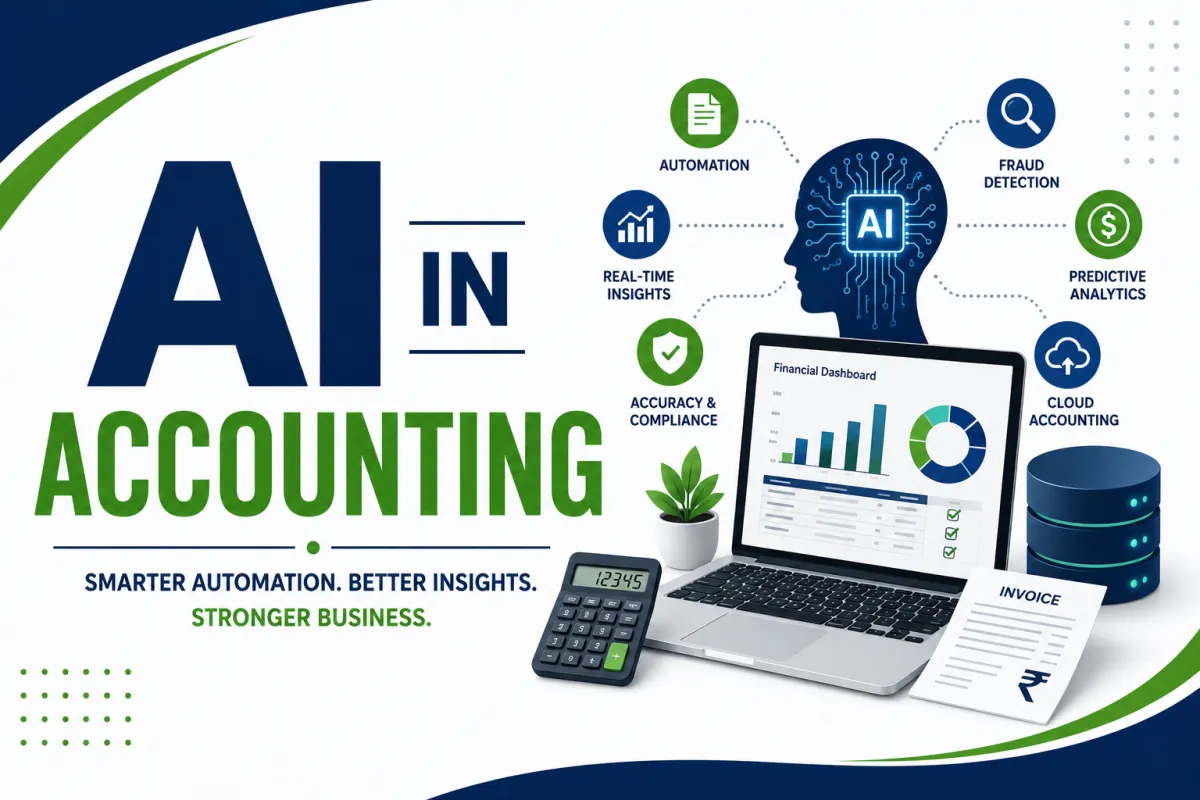
Artificial Intelligence (AI) is transforming the accounting industry by automating routine tasks, improving accuracy, enhancing financial analysis, and supporting faster decision-making. Businesses of all sizes are increasingly adopting AI-powered accounting solutions to improve efficiency and reduce operational costs.



Comments (0)
Please login to comment.