Bookkeeping is one of the most important financial functions of every business, as it involves recording daily financial transactions, maintaining accurate financial records, and preparing the foundation for accounting and tax compliance. Traditionally, bookkeeping required significant manual effort, making it time-consuming and susceptible to human error. With the advancement of technology, automation has transformed bookkeeping by enabling businesses to complete routine accounting tasks faster, more accurately, and with minimal manual intervention.
Automation in bookkeeping involves using accounting software, artificial intelligence (AI), machine learning, and cloud-based systems to record, organize, and process financial transactions automatically. Instead of manually entering every invoice, receipt, payment, or expense, automated systems can capture financial data directly from bank accounts, invoices, payment gateways, and other integrated business applications. This significantly reduces repetitive work while improving efficiency.
One of the biggest advantages of bookkeeping automation is improved accuracy. Automated systems minimize manual data entry errors, duplicate transactions, calculation mistakes, and missing records. Intelligent software can identify inconsistencies, categorize transactions correctly, and maintain organized financial records that support accurate financial reporting and compliance.
Invoice management becomes much more efficient through automation. Businesses can automatically generate invoices, send recurring invoices, track payment status, issue payment reminders, and record customer receipts without manual intervention. This improves cash flow management while reducing delays in collections.
Bank reconciliation is another area where automation provides significant benefits. Modern accounting software can automatically import bank transactions, match payments with accounting records, identify unmatched transactions, and prepare reconciliation reports. Automated reconciliation saves considerable time and ensures that financial records remain accurate.
Expense management is also simplified through automated bookkeeping. Digital receipt scanning, expense categorization, approval workflows, and reimbursement processing reduce paperwork while providing better control over business expenses. Employees can upload receipts electronically, allowing finance teams to process claims quickly and accurately.
Automation supports better tax compliance by calculating GST, preparing tax reports, tracking input tax credits, maintaining digital records, and generating statutory reports required for regulatory filings. Businesses can meet tax deadlines more efficiently while reducing the risk of compliance errors and penalties.
Cloud-based bookkeeping systems allow business owners, accountants, auditors, and finance teams to access financial information securely from anywhere. Real-time collaboration enables multiple users to work on the same financial records while ensuring data security through encryption, automatic backups, and user access controls.
Automation also enhances financial reporting by generating Profit and Loss Statements, Balance Sheets, Cash Flow Statements, ageing reports, budgeting reports, and management dashboards instantly. Real-time financial insights help business owners monitor performance, identify trends, control costs, and make informed business decisions.
Although automation handles many routine bookkeeping tasks, professional accountants continue to play an essential role in interpreting financial information, ensuring regulatory compliance, providing tax planning, conducting audits, and offering strategic financial advice. Automation complements accounting professionals by allowing them to focus on higher-value financial activities.
Businesses should carefully evaluate accounting software based on features, security, scalability, integration capabilities, customer support, GST compliance, pricing, and ease of use before implementing automation. Proper employee training and well-defined internal controls further ensure successful adoption of automated bookkeeping systems.
Professional guidance from Chartered Accountants, accounting consultants, and technology experts can help businesses implement bookkeeping automation, migrate financial data, establish efficient workflows, maintain statutory compliance, and maximize operational efficiency. Expert assistance ensures smooth implementation while reducing business risks.
Automation in bookkeeping is transforming financial management by making accounting faster, more accurate, and highly efficient. By adopting automated accounting systems, integrating business processes, maintaining strong financial controls, and combining technology with professional expertise, businesses can improve productivity, strengthen compliance, reduce operational costs, and support sustainable long-term growth in today’s digital economy.
Automation in Bookkeeping: How Technology is Revolutionizing Modern Business Accounting

Akshita tyagi
@ tyagiakshita78@gmail.com
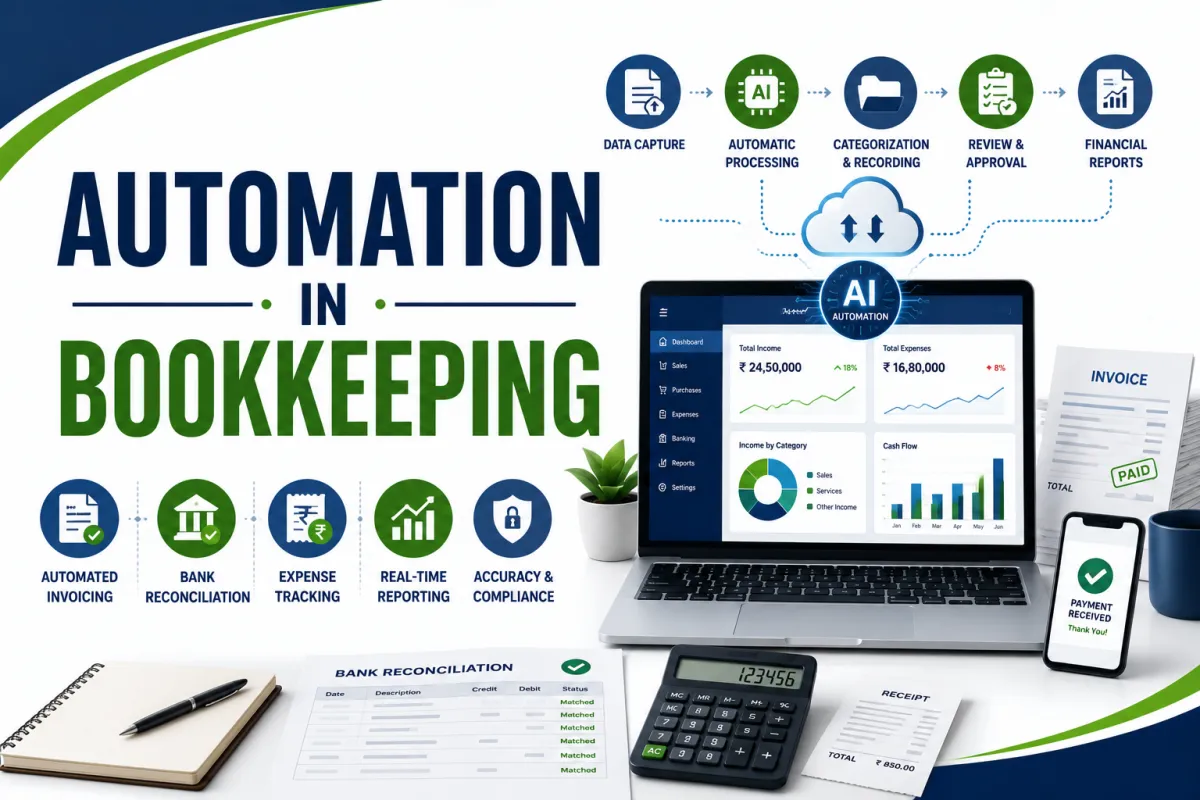
Bookkeeping automation uses technology and artificial intelligence to simplify routine accounting tasks such as recording transactions, invoicing, bank reconciliation, expense tracking, and financial reporting. It helps businesses save time, improve accuracy, reduce costs, and focus on strategic growth.



Comments (0)
Please login to comment.