Company Registration Process in India

Akshita tyagi
@ tyagiakshita78@gmail.com
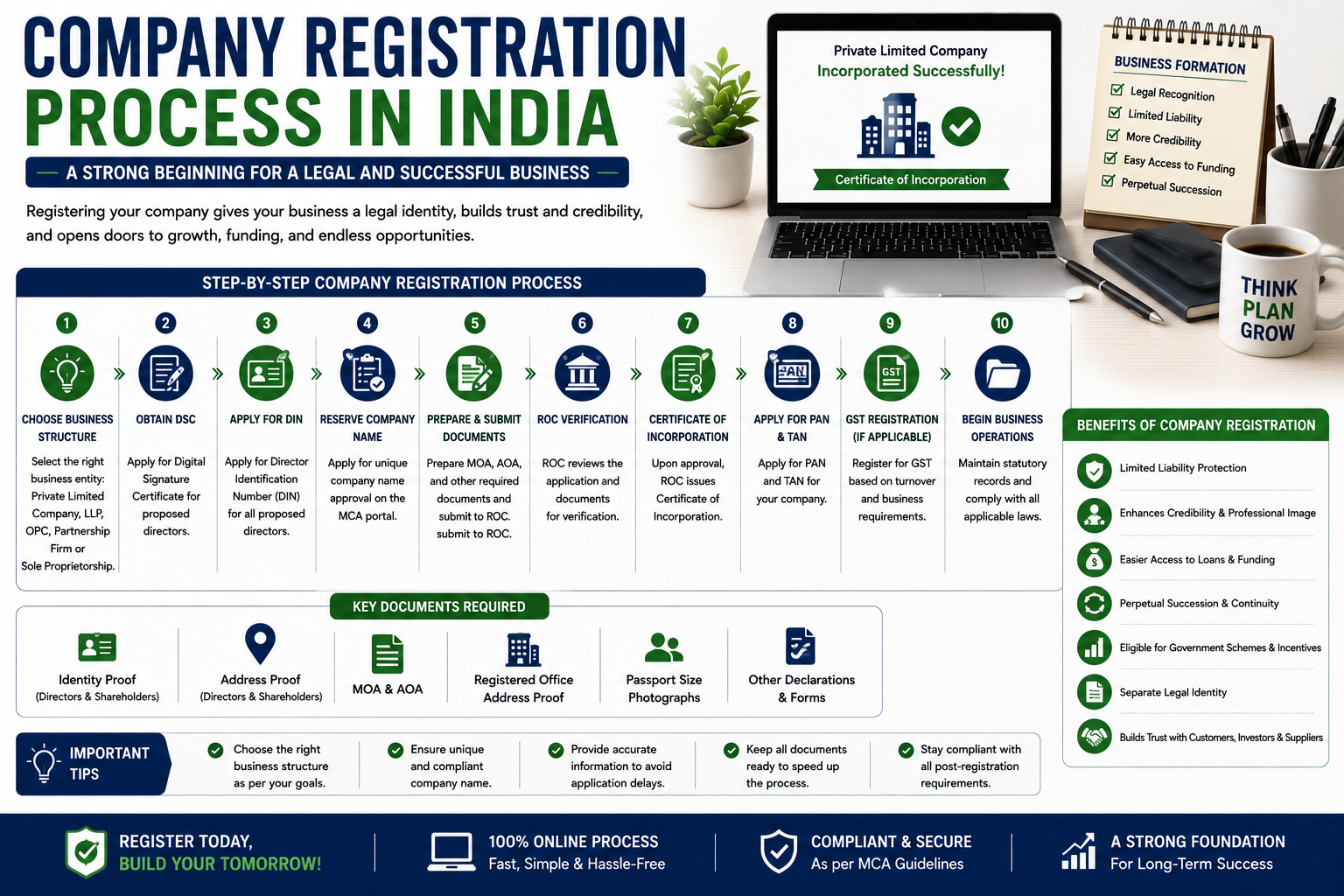
Registering a company in India is the first step toward establishing a legally recognized business. A proper company registration provides credibility, legal protection, and access to various business growth opportunities.
Starting a business in India requires proper legal registration to ensure compliance with government regulations and to establish a strong foundation for future growth. The company registration process in India has become more streamlined and efficient due to digital initiatives introduced by the government. Registering a company not only provides legal recognition but also enhances credibility among customers, investors, suppliers, and financial institutions. The first step in the company registration process is deciding the type of business entity that best suits the organization’s objectives. Common options include Private Limited Company, Limited Liability Partnership (LLP), One Person Company (OPC), Partnership Firm, and Sole Proprietorship. Among these, the Private Limited Company structure is one of the most preferred choices for startups and growing businesses due to its separate legal identity and limited liability protection. After selecting the business structure, promoters must obtain a Digital Signature Certificate (DSC), which is required for electronically signing registration documents. The next step involves applying for a Director Identification Number (DIN) for proposed directors. Once these requirements are completed, applicants can reserve a unique company name through the Ministry of Corporate Affairs (MCA) portal. The chosen name must comply with MCA guidelines and should not be identical or similar to existing registered entities. Following name approval, incorporation documents such as the Memorandum of Association (MOA), Articles of Association (AOA), identity proofs, address proofs, and registered office details must be submitted. The application is then reviewed by the Registrar of Companies (ROC). Upon successful verification, the ROC issues a Certificate of Incorporation, which serves as official proof of company registration. After incorporation, businesses must apply for a Permanent Account Number (PAN) and Tax Deduction and Collection Account Number (TAN). Depending on the nature and turnover of the business, GST registration and other applicable licenses may also be required. Maintaining proper statutory records, accounting books, and regulatory compliance is essential after registration to ensure smooth business operations. Company registration offers numerous benefits, including limited liability protection, improved credibility, easier access to funding, perpetual succession, and eligibility for government schemes and startup incentives. It also creates a professional image that can help attract customers and investors. With the availability of online registration systems, the incorporation process has become faster and more convenient than ever before. By understanding the company registration process and completing all legal formalities correctly, entrepreneurs can establish a strong and compliant business structure that supports long-term growth and success in the competitive Indian market.



Comments (0)
Please login to comment.