Non-Governmental Organizations (NGOs) play a significant role in addressing social, educational, environmental, cultural, and humanitarian issues across India. To operate legally and gain public trust, an NGO should be properly registered under the applicable laws. NGO registration not only provides legal status but also helps organizations receive donations, apply for grants, open bank accounts, and collaborate with government and private institutions. In India, NGOs are commonly registered as Trusts, Societies, or Section 8 Companies, depending on their objectives and operational structure.
The first step in the NGO registration process is deciding the most suitable legal structure. A Trust is generally established for charitable purposes and is governed by the Indian Trusts Act. A Society is formed by a group of individuals working towards a common social objective and is registered under the Societies Registration Act. A Section 8 Company is incorporated under the Companies Act and is often preferred for larger organizations due to its structured governance and higher credibility. Once the structure is selected, the founders must prepare the required documents, including identity proof, address proof, photographs of members, and documents relating to the registered office address.
For a Trust, a Trust Deed must be drafted outlining the objectives, rules, and management structure of the organization. For a Society, a Memorandum of Association (MOA) and Rules & Regulations must be prepared and signed by the founding members. In the case of a Section 8 Company, incorporation documents are submitted through the Ministry of Corporate Affairs (MCA) portal along with Digital Signature Certificates (DSC) and Director Identification Numbers (DIN) for the directors. After submission of the necessary documents and prescribed fees, the concerned registration authority reviews the application. Upon approval, the NGO receives a registration certificate, which serves as proof of legal existence.
After registration, NGOs may apply for PAN, TAN, bank account opening, and tax exemptions under Sections 12A and 80G of the Income Tax Act, which can provide benefits to both the organization and its donors. Depending on the nature of activities and funding sources, additional registrations such as FCRA may also be required to receive foreign contributions. Maintaining proper accounting records, annual filings, and statutory compliance is essential for smooth operations and continued credibility.
Registering an NGO provides numerous benefits, including legal recognition, improved transparency, donor confidence, eligibility for government grants, and long-term sustainability. A properly registered NGO is better positioned to make a meaningful social impact while operating in compliance with legal requirements. By understanding the registration process and fulfilling all necessary formalities, social entrepreneurs and charitable groups can build a strong foundation for their mission and contribute effectively to community development across India.
NGO Registration Process in India

Akshita tyagi
@ tyagiakshita78@gmail.com
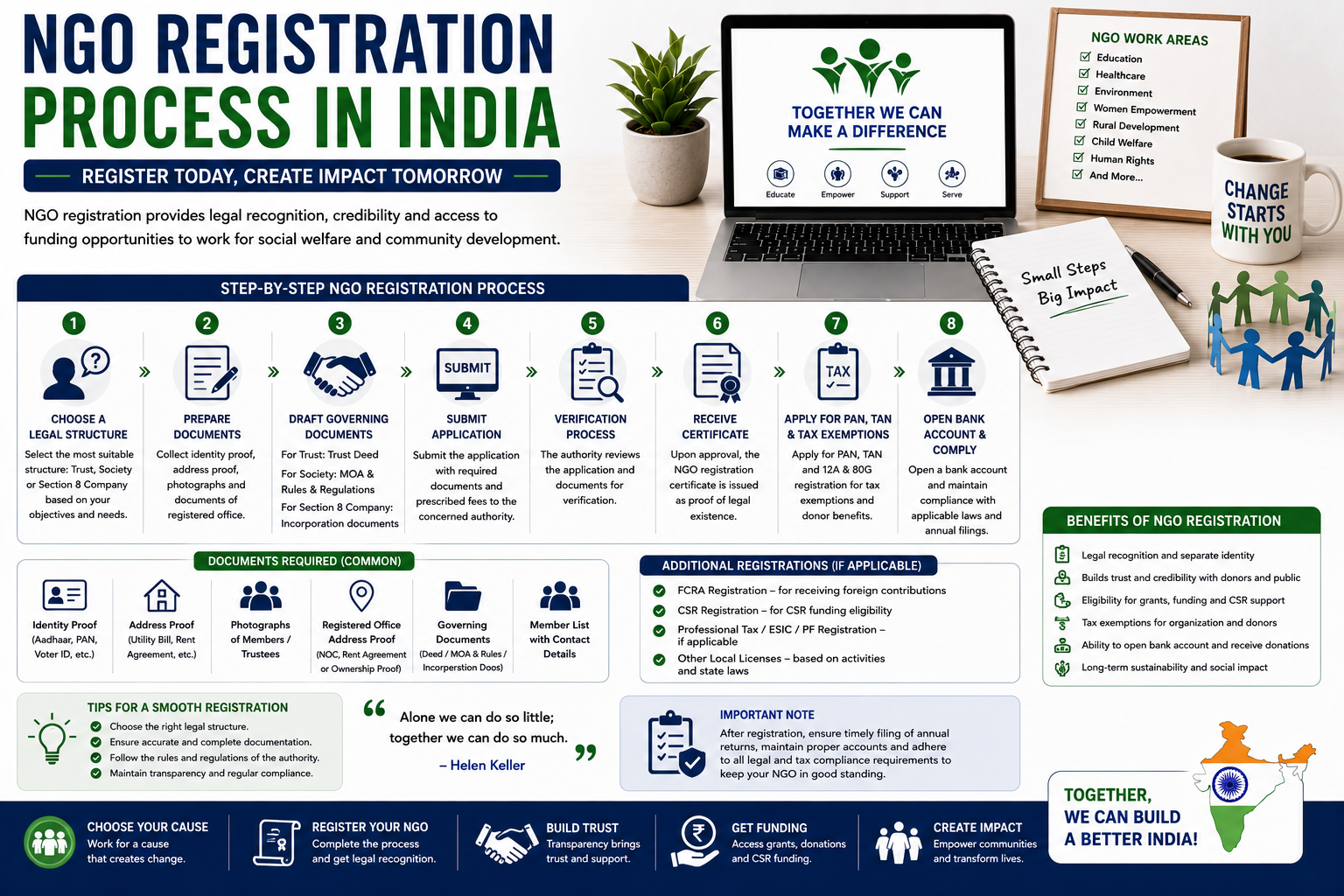
Registering an NGO in India is an important step for individuals and groups looking to work for social welfare, education, healthcare, environmental protection, or other charitable causes. Proper registration provides legal recognition, credibility, and access to funding opportunities.



Comments (0)
Please login to comment.