Introduction
The digital revolution has transformed nearly every industry, and accounting is no exception. Over the past decade, businesses have moved away from paper-based bookkeeping and manual tax filing toward intelligent, cloud-based accounting systems. One of the most significant catalysts behind this transformation has been the implementation of the Goods and Services Tax (GST), which introduced a unified tax framework and encouraged businesses to adopt digital financial practices.
As we move through 2026, GST compliance has become more technology-driven than ever before. Governments are investing in digital infrastructure, businesses are embracing automation, and accounting professionals are relying on advanced software to manage tax calculations, invoicing, financial reporting, and compliance.
Digital accounting is no longer limited to large corporations. Small businesses, startups, freelancers, and enterprises are all adopting cloud accounting platforms to improve efficiency, reduce costs, and simplify GST compliance. The future of accounting lies in automation, real-time financial insights, and intelligent technologies that eliminate repetitive tasks while empowering finance professionals to make strategic decisions.
Understanding GST and Digital Accounting
GST is a destination-based indirect tax system designed to simplify taxation by replacing multiple indirect taxes with a single framework. It has significantly improved transparency and standardized taxation across businesses.
Digital accounting refers to the use of cloud-based accounting software and digital technologies to record, manage, analyze, and report financial transactions electronically. Instead of maintaining physical ledgers or spreadsheets, businesses now rely on integrated accounting platforms that automate financial operations.
When GST and digital accounting work together, businesses experience faster tax filing, accurate record management, automated invoice generation, and better financial visibility.
Why Businesses Are Moving Toward Digital Accounting
Traditional accounting methods often involve manual calculations, paperwork, and repetitive processes that increase the risk of errors and consume valuable time. Digital accounting eliminates these inefficiencies through automation and cloud technology.
Businesses are increasingly adopting digital accounting because it offers:
Faster financial reporting
Automated GST calculations
Cloud-based data storage
Secure financial records
Easy access from anywhere
Reduced operational costs
Better collaboration with accountants
Improved compliance with tax regulations
The shift toward digital finance is helping organizations become more productive while enabling faster business growth.
Key Trends Shaping the Future of GST and Digital Accounting
1. Cloud-Based Accounting Will Become the Industry Standard
Cloud accounting platforms are replacing traditional desktop accounting software. Businesses can now access financial records securely from any location using laptops, tablets, or smartphones.
Cloud technology enables real-time collaboration between business owners, accountants, auditors, and tax consultants. This flexibility is particularly valuable for remote teams and businesses operating across multiple locations.
Cloud accounting also provides automatic software updates, secure backups, and scalable storage without requiring expensive hardware.
2. AI-Powered Automation
Artificial Intelligence is transforming accounting by automating repetitive financial tasks.
AI-powered accounting systems can:
Categorize transactions automatically
Match invoices with payments
Detect duplicate entries
Predict cash flow
Identify unusual financial activities
Generate financial reports
Instead of spending hours entering financial data manually, accountants can focus on analysis, planning, and advisory services.
3. E-Invoicing Will Continue to Expand
Electronic invoicing has become one of the most significant developments in GST compliance.
Businesses can now generate invoices digitally while ensuring they comply with government standards. E-invoicing reduces paperwork, improves invoice accuracy, speeds up payment processing, and minimizes tax-related errors.
Future accounting systems will integrate e-invoicing directly into business workflows, creating a fully automated invoicing process.
4. Real-Time GST Compliance
Modern accounting software continuously monitors GST transactions and automatically calculates tax liabilities.
Instead of preparing GST returns manually at the end of each filing period, businesses receive real-time tax updates throughout the month.
This reduces filing errors and improves compliance with changing tax regulations.
5. Data Analytics for Better Financial Decisions
Accounting software is evolving beyond bookkeeping.
Modern platforms provide dashboards showing:
Revenue trends
Business expenses
Profit margins
Cash flow
Tax liabilities
Outstanding payments
These insights enable business owners to make informed financial decisions based on real-time information.
Benefits of Digital Accounting for GST Compliance
Improved Accuracy
Manual accounting often leads to data entry mistakes, incorrect tax calculations, and duplicate transactions.
Digital accounting software automates these processes, significantly reducing errors and improving financial accuracy.
Time Savings
Automation eliminates repetitive accounting tasks such as invoice creation, GST calculation, reconciliation, and report generation.
Finance teams can complete work in minutes that previously required several hours.
Lower Operational Costs
Businesses reduce expenses associated with paper records, manual bookkeeping, storage, and administrative work.
Automation also decreases the need for extensive manual labor while improving overall efficiency.
Enhanced Financial Transparency
Digital accounting systems provide complete visibility into business finances.
Business owners can monitor revenue, expenses, tax liabilities, and profitability through interactive dashboards.
This transparency improves financial planning and strategic decision-making.
Stronger Data Security
Cloud accounting platforms use advanced encryption, secure authentication, and automatic backups to protect financial information.
Compared to paper records, digital accounting significantly reduces the risk of data loss.
Challenges Businesses May Face
Despite numerous benefits, digital transformation presents several challenges.
Initial Investment
Businesses must invest in accounting software, employee training, and digital infrastructure.
However, these costs are often recovered through increased productivity and reduced operational expenses.
Employee Training
Employees accustomed to manual accounting methods may require training to effectively use digital accounting platforms.
Continuous learning becomes essential as technology evolves.
Cybersecurity Risks
Since financial information is stored digitally, businesses must implement strong cybersecurity practices, including secure passwords, multi-factor authentication, and regular software updates.
Regulatory Changes
GST regulations continue to evolve, making it important for businesses to use software that stays updated with the latest compliance requirements.
The Role of Accountants in the Digital Era
Contrary to popular belief, digital accounting will not replace accountants.
Instead, it is changing their responsibilities.
Modern accountants are becoming financial advisors who help businesses interpret financial data, improve profitability, manage risks, and develop growth strategies.
Automation handles repetitive tasks, allowing professionals to focus on high-value services that require human expertise and critical thinking.
The Future of GST and Digital Accounting
The future of accounting will be driven by intelligent technologies that combine automation, cloud computing, artificial intelligence, and data analytics.
Businesses can expect:
Fully automated bookkeeping
AI-assisted tax planning
Predictive financial reporting
Real-time GST compliance
Paperless accounting systems
Faster financial audits
Blockchain-supported transaction verification
Advanced business intelligence dashboards
These innovations will create more transparent, efficient, and secure financial ecosystems.
Organizations that embrace digital transformation early will gain a competitive advantage by reducing costs, improving compliance, and making faster business decisions.
Conclusion
The future of GST and digital accounting is centered on innovation, automation, and efficiency. As governments continue to digitize tax systems and businesses increasingly adopt cloud-based accounting solutions, financial management is becoming more accurate, transparent, and data-driven than ever before.
Digital accounting empowers businesses to simplify GST compliance, reduce manual work, improve financial reporting, and make informed strategic decisions. While adopting new technologies may require investment and training, the long-term benefits far outweigh the challenges.
In the years ahead, digital accounting will become an essential part of every successful business. Organizations that embrace modern accounting technologies today will be better prepared for tomorrow's financial landscape, while professionals who continuously develop their digital skills will remain valuable in an increasingly technology-driven world.
The future of finance is not just digital—it is intelligent, connected, and built for sustainable business growth.
The Future of GST and Digital Accounting

Manjeet saini
@ Mnjeet_saini
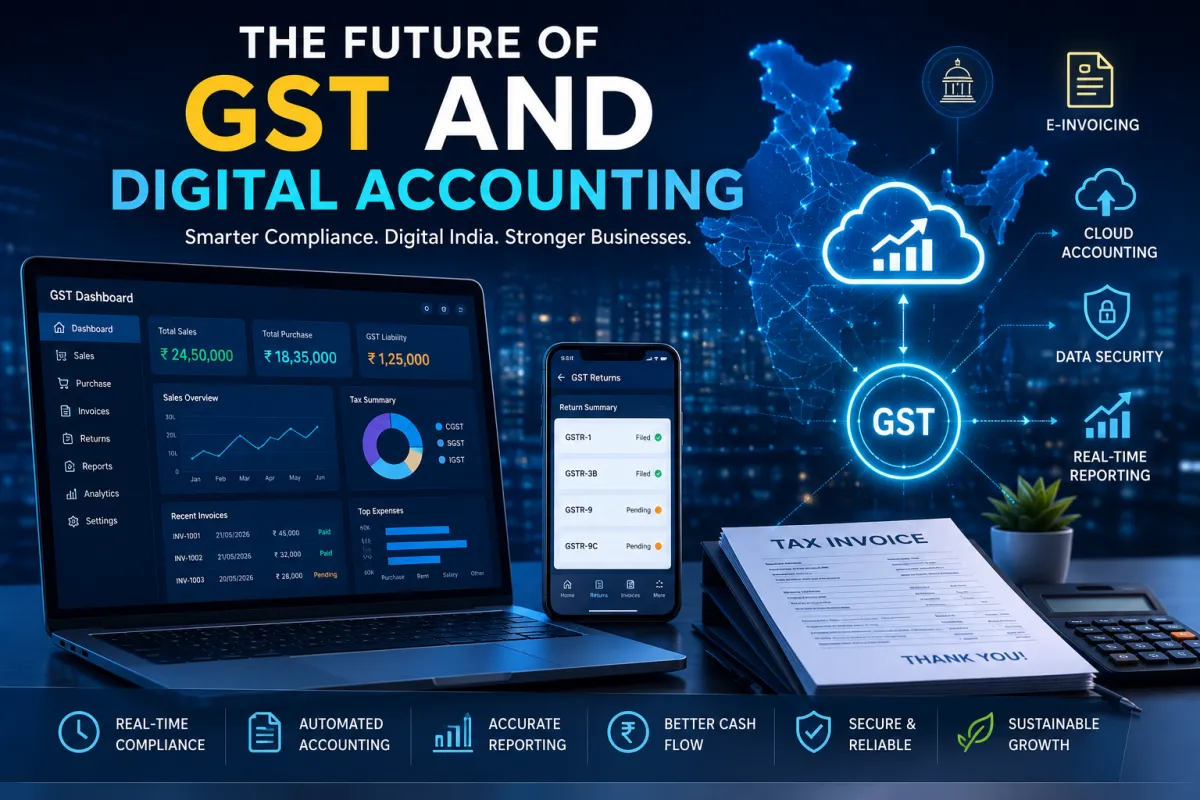
The accounting landscape is evolving rapidly, and one of the biggest drivers of this transformation is the combination of Goods and Services Tax (GST) and Digital Accounting. Governments are embracing digital tax systems, while businesses are shifting from traditional bookkeeping to cloud-based accounting platforms that offer automation, real-time reporting, and seamless compliance.
In 2026, digital accounting is no longer just an option—it is becoming the standard for businesses of all sizes. Modern accounting software, AI-powered automation, e-invoicing, and cloud technology are helping organizations reduce errors, improve financial transparency, and stay compliant with changing GST regulations. This article explores how GST and digital accounting are shaping the future of finance, the latest trends, key benefits, challenges, and why businesses must adopt digital solutions to remain competitive.
In 2026, digital accounting is no longer just an option—it is becoming the standard for businesses of all sizes. Modern accounting software, AI-powered automation, e-invoicing, and cloud technology are helping organizations reduce errors, improve financial transparency, and stay compliant with changing GST regulations. This article explores how GST and digital accounting are shaping the future of finance, the latest trends, key benefits, challenges, and why businesses must adopt digital solutions to remain competitive.


Comments (0)
Please login to comment.