Who Needs GST Registration in India?
GST registration is one of the first legal requirements many businesses encounter after starting operations. While some businesses must register immediately, others only need to register after crossing the prescribed turnover limit.
Knowing the rules can help business owners avoid unnecessary penalties and ensure smooth business operations.
What is GST Registration?
GST Registration is the process through which a business obtains a unique Goods and Services Tax Identification Number (GSTIN) from the government. Once registered, the business can legally collect GST from customers and comply with GST laws.
Who Must Register Under GST?
The following categories of businesses and individuals generally require GST registration if they meet the applicable legal conditions.
1. Businesses Crossing the Turnover Limit
Businesses whose annual turnover exceeds the prescribed threshold are generally required to register under GST.
The turnover limit may differ based on:
Nature of business
Type of goods or services
State in which the business operates
2. Businesses Selling Across States
Businesses supplying goods or services to customers in different states may be required to obtain GST registration, depending on the applicable provisions.
3. E-Commerce Sellers
Businesses selling products through online marketplaces such as Amazon, Flipkart, or Meesho may require GST registration based on the nature of their business and current GST rules.
4. Online Service Providers
Businesses providing digital services, software, consulting, designing, marketing, or other online services may need GST registration depending on turnover and transaction type.
5. Casual Taxable Persons
Individuals participating in exhibitions, trade fairs, seasonal markets, or temporary business events may require GST registration if covered under GST provisions.
6. Non-Resident Taxable Persons
Foreign businesses or individuals supplying taxable goods or services in India may need GST registration before starting business activities.
7. Input Service Distributors (ISD)
Companies distributing input tax credit among different branches may require registration as an Input Service Distributor.
8. Businesses Liable Under Reverse Charge
Businesses required to pay tax under the Reverse Charge Mechanism (RCM) should review the applicable GST provisions to determine registration requirements.
Who May Not Need GST Registration?
Some businesses may not require GST registration if they satisfy applicable exemption conditions.
Examples include:
Businesses below the prescribed turnover threshold.
Persons exclusively dealing in exempt goods or services.
Certain agricultural activities, subject to GST provisions.
Eligibility depends on the specific facts and applicable law.
Benefits of GST Registration
Even when registration is voluntary, it may offer several advantages.
Legal Recognition
A registered business gains official tax recognition.
Input Tax Credit (ITC)
Eligible businesses may claim input tax credit on business purchases, subject to GST rules.
Better Business Opportunities
Many companies prefer working with GST-registered suppliers.
Interstate Expansion
GST registration can simplify business expansion across different states where applicable.
Improved Business Credibility
GST registration may increase customer confidence and strengthen the business's professional image.
Consequences of Not Registering
If GST registration is legally required but not obtained, businesses may face consequences such as:
Monetary penalties under applicable law.
Interest on unpaid tax.
Compliance notices.
Restrictions on claiming eligible tax benefits.
The exact consequences depend on the circumstances and applicable GST provisions.
Common Mistakes
Many new business owners make avoidable mistakes such as:
Assuming every business requires GST registration.
Ignoring turnover calculations.
Delaying registration after becoming eligible.
Not maintaining proper business records.
Misunderstanding GST exemption rules.
Understanding the eligibility criteria can help avoid these issues.
Frequently Asked Questions (FAQs)
Is GST registration compulsory for every business?
No. GST registration depends on eligibility criteria prescribed under GST law.
Can I register voluntarily?
Yes. Eligible businesses may apply for voluntary GST registration even if they are not legally required to register.
Do freelancers need GST registration?
It depends on factors such as turnover, the nature of services, and applicable GST provisions.
Can a home-based business register under GST?
Yes. Home-based businesses may obtain GST registration if they meet the applicable requirements.
What happens after GST registration?
Once registered, businesses are generally required to comply with GST obligations, including issuing GST-compliant invoices and filing applicable returns.
Conclusion
GST registration is an important compliance requirement for many businesses in India. Whether registration is mandatory depends on factors such as turnover, business activities, and applicable GST provisions. Before applying—or deciding not to apply—it is advisable to understand the current rules and ensure your business remains compliant with the law.
Who Needs GST Registration in India? Eligibility, Rules & Exceptions (2026)

Manjeet saini
@ Mnjeet_saini
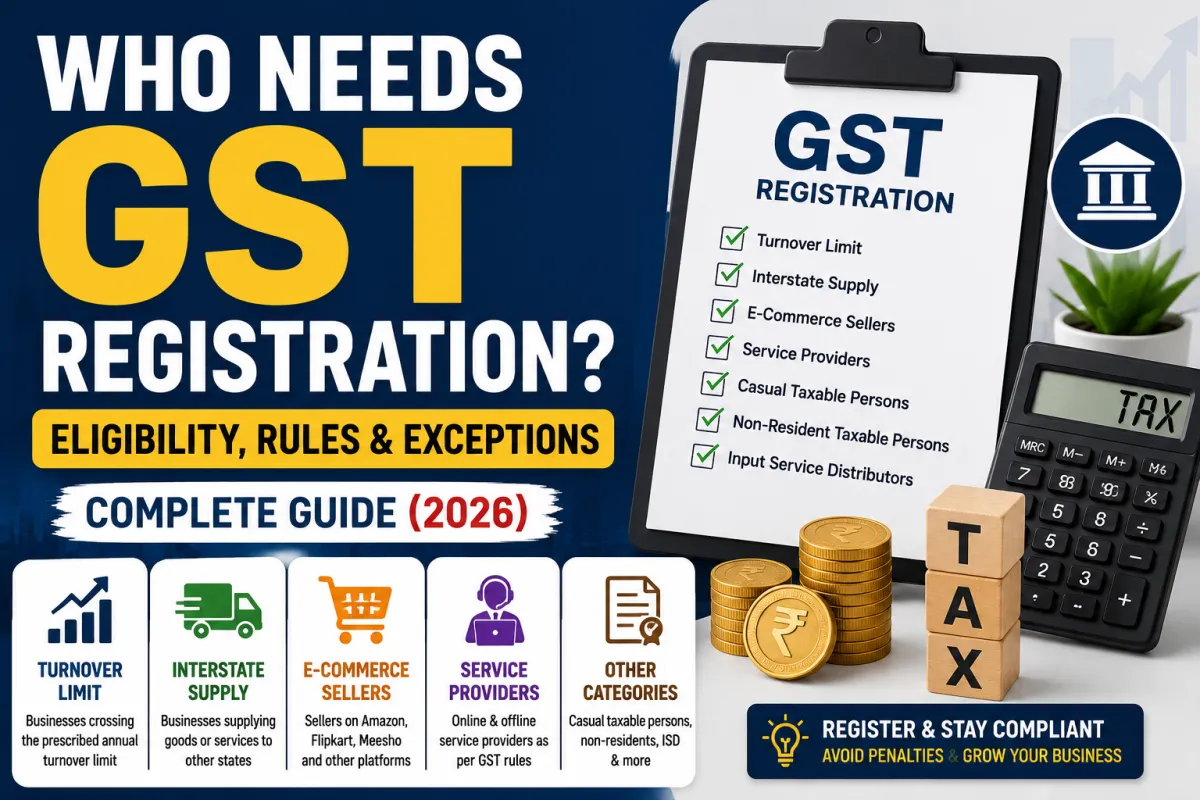
Not every business in India is required to register under the Goods and Services Tax (GST) system. GST registration depends on factors such as annual turnover, the type of goods or services offered, the location of the business, and certain business activities. Understanding whether your business needs GST registration is essential to remain compliant with tax laws and avoid penalties. This guide explains the eligibility criteria, mandatory registration cases, exemptions, and frequently asked questions in simple language.


Comments (0)
Please login to comment.