Regular financial audits are an essential part of sound business management and corporate governance. A financial audit is a systematic examination of a company’s financial statements, accounting records, and supporting documents to determine whether they accurately reflect the organization’s financial position. Conducted by qualified professionals, financial audits help businesses maintain transparency, detect errors, improve internal controls, and ensure compliance with applicable accounting standards and legal requirements. Whether required by law or conducted voluntarily, regular financial audits provide valuable insights that contribute to the overall financial health and credibility of an organization.
One of the most significant benefits of regular financial audits is the accuracy of financial reporting. Auditors review books of accounts, invoices, bank statements, ledgers, payroll records, tax filings, and other financial documents to identify errors, inconsistencies, or material misstatements. Accurate financial statements enable business owners, investors, lenders, and management to make informed financial decisions based on reliable information.
Financial audits also strengthen internal control systems. During the audit process, weaknesses in accounting procedures, financial controls, authorization systems, documentation practices, and operational processes may be identified. Auditors often recommend practical improvements that help businesses reduce financial risks, prevent fraud, safeguard assets, and improve operational efficiency. Strong internal controls contribute to better governance and long-term organizational stability.
Another important advantage of regular financial audits is improved statutory compliance. Auditors evaluate whether businesses have complied with applicable tax laws, accounting standards, corporate regulations, payroll requirements, GST provisions, TDS obligations, and other statutory requirements where applicable. Identifying compliance gaps at an early stage enables organizations to take corrective measures before they result in penalties, legal disputes, or regulatory actions.
Regular financial audits also enhance business credibility. Audited financial statements increase confidence among shareholders, investors, banks, financial institutions, suppliers, customers, and government authorities. Businesses with transparent and reliable financial records often find it easier to obtain loans, attract investors, secure government contracts, and establish long-term business relationships. Strong financial credibility supports sustainable growth and improves the organization’s professional reputation.
Businesses benefit from improved financial planning and decision-making through regular audits. Independent evaluation of financial performance provides management with a clearer understanding of profitability, cash flow, operational efficiency, expenditure patterns, and financial risks. These insights enable business leaders to make strategic decisions regarding expansion, budgeting, investments, cost management, and resource allocation.
Maintaining organized financial records throughout the year significantly simplifies the audit process. Businesses should preserve invoices, vouchers, contracts, payroll records, bank reconciliations, tax filings, inventory records, fixed asset registers, and statutory documents in an organized manner. Using reliable accounting software further improves data accuracy, reduces manual errors, and supports efficient financial reporting.
Although audits primarily focus on verifying financial information, they also encourage organizations to adopt stronger governance practices and maintain greater accountability. Regular audits promote a culture of transparency, disciplined record-keeping, and continuous improvement across financial operations. Businesses that conduct periodic audits are generally better prepared to respond to regulatory changes, tax assessments, and market challenges.
The benefits of regular financial audits extend far beyond legal compliance. They strengthen financial management, improve internal controls, enhance stakeholder confidence, reduce operational risks, and support informed business decisions. By maintaining accurate accounting records, implementing effective financial systems, and conducting regular audits, businesses can build a strong foundation for long-term success while ensuring compliance with evolving regulatory requirements. Regular financial audits are an investment in transparency, credibility, and sustainable business growth.
Benefits of Regular Financial Audits: Why Every Business Should Conduct Them

Akshii
@ Manaksh
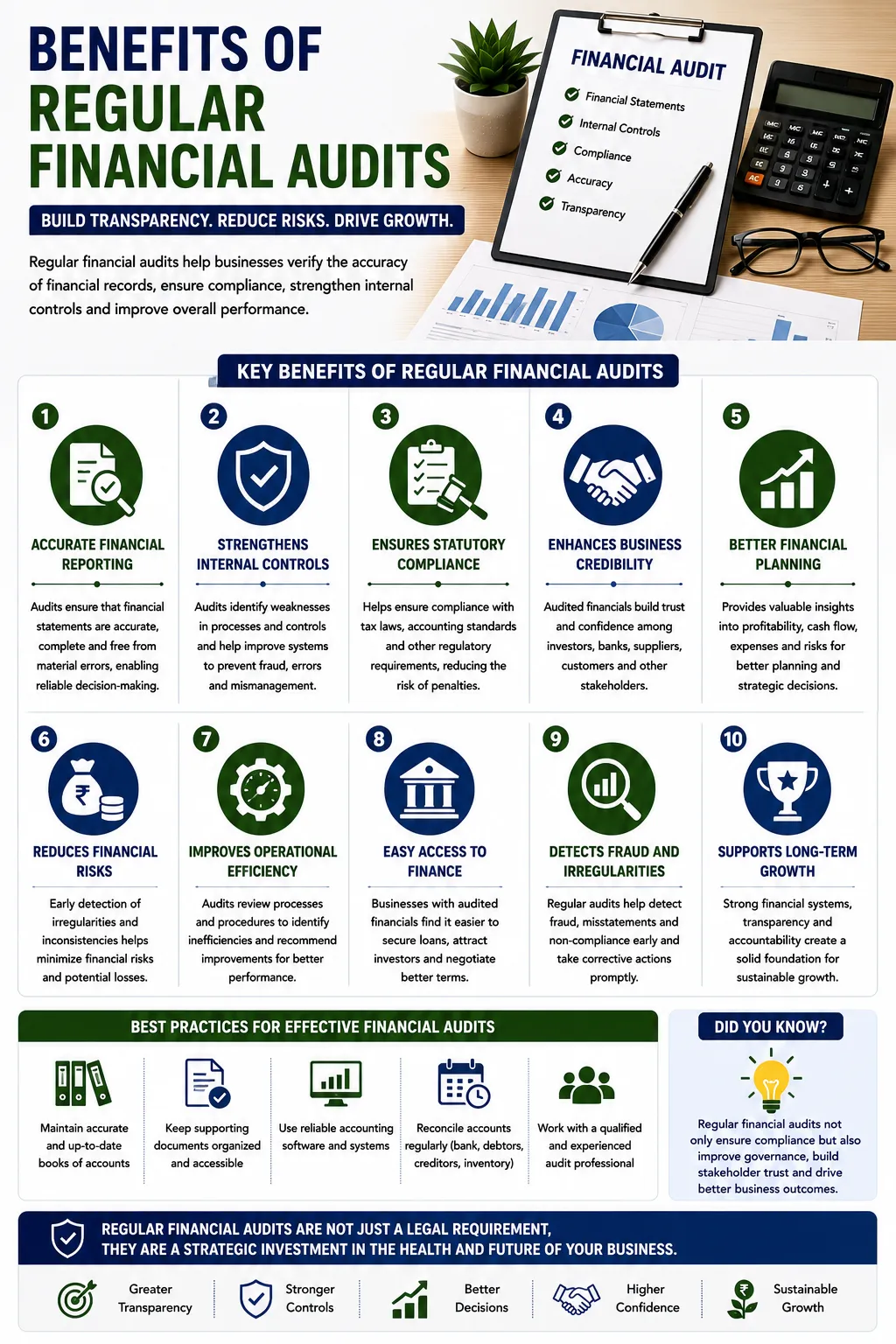
Regular financial audits help businesses verify the accuracy of their financial records, strengthen internal controls, and ensure compliance with applicable laws. They improve transparency, build stakeholder confidence, and support better financial decision-making for long-term business growth.



Comments (0)
Please login to comment.