Exporting products and services allows businesses to reach international customers, diversify revenue sources, and strengthen long-term growth. To support Indian exporters, the Government of India has introduced various Export Promotion Schemes that encourage businesses to participate in global trade while improving their competitiveness. These schemes provide financial assistance, export incentives, market development support, infrastructure benefits, and policy guidance to eligible exporters. Understanding these initiatives helps businesses take advantage of government support while expanding their international presence.
The primary objective of Export Promotion Schemes is to increase India’s exports by reducing barriers faced by businesses entering international markets. These schemes encourage manufacturing, service exports, technology development, product quality improvement, and market diversification. By supporting exporters through various incentives and assistance programs, the government aims to strengthen India’s position in global trade.
Before participating in export activities, businesses should complete the necessary registrations and statutory compliances. Obtaining an Import Export Code (IEC), GST registration where applicable, Udyam Registration for eligible MSMEs, and other industry-specific licenses forms the foundation of compliant export operations. Businesses should also understand customs regulations, foreign trade policies, and documentation requirements before commencing exports.
A well-planned export strategy is essential for long-term success. Businesses should identify suitable international markets, understand customer demand, evaluate competition, develop pricing strategies, establish distribution channels, and comply with destination-country regulations. Thorough market research enables exporters to minimize risks while improving business opportunities.
Government export promotion initiatives often support businesses through trade fairs, international exhibitions, export awareness programs, buyer-seller meets, quality certification assistance, export financing support, and market development activities. Participation in these programs helps businesses connect with overseas buyers and expand their international business network.
Maintaining accurate financial and commercial records is equally important for exporters. Businesses should preserve invoices, shipping documents, export contracts, purchase orders, customs documentation, bank realization certificates, GST records, accounting books, and other statutory records. Proper documentation simplifies audits, tax compliance, export incentives, and regulatory verification.
Efficient financial management plays a significant role in export success. Businesses should monitor foreign currency transactions, working capital requirements, receivables, inventory, logistics costs, and cash flow. Strong financial discipline enables exporters to manage international operations effectively while maintaining profitability.
Technology can further simplify export management. Modern accounting and ERP software assist businesses in invoicing, inventory management, GST compliance, export documentation, financial reporting, foreign currency accounting, and customer relationship management. Digital systems improve operational efficiency and reduce administrative workload.
Professional guidance from Chartered Accountants, export consultants, customs experts, and international trade advisors can help businesses understand export regulations, maintain statutory compliance, prepare documentation, optimize tax benefits, and navigate international trade procedures. Expert support reduces compliance risks and improves export readiness.
Businesses should also remain updated with changes in the Foreign Trade Policy, customs regulations, export incentive programs, and international trade agreements. Since export policies and global market conditions evolve regularly, staying informed enables businesses to adapt quickly and take advantage of emerging opportunities.
MSMEs and startups can particularly benefit from Export Promotion Schemes by leveraging government assistance to enter international markets with reduced financial and operational challenges. Combining export incentives with effective business planning and quality standards helps enterprises compete successfully in the global marketplace.
Export Promotion Schemes provide valuable opportunities for Indian businesses to grow beyond domestic markets and establish a strong international presence. By completing the necessary registrations, maintaining accurate documentation, complying with statutory requirements, implementing sound financial management practices, and utilizing available government support, businesses can expand their exports confidently and sustainably. These initiatives continue to play a crucial role in strengthening India’s global trade and supporting long-term economic development.
Export Promotion Schemes: Complete Guide to Government Support for Indian Exporters

Akshii
@ Manaksh
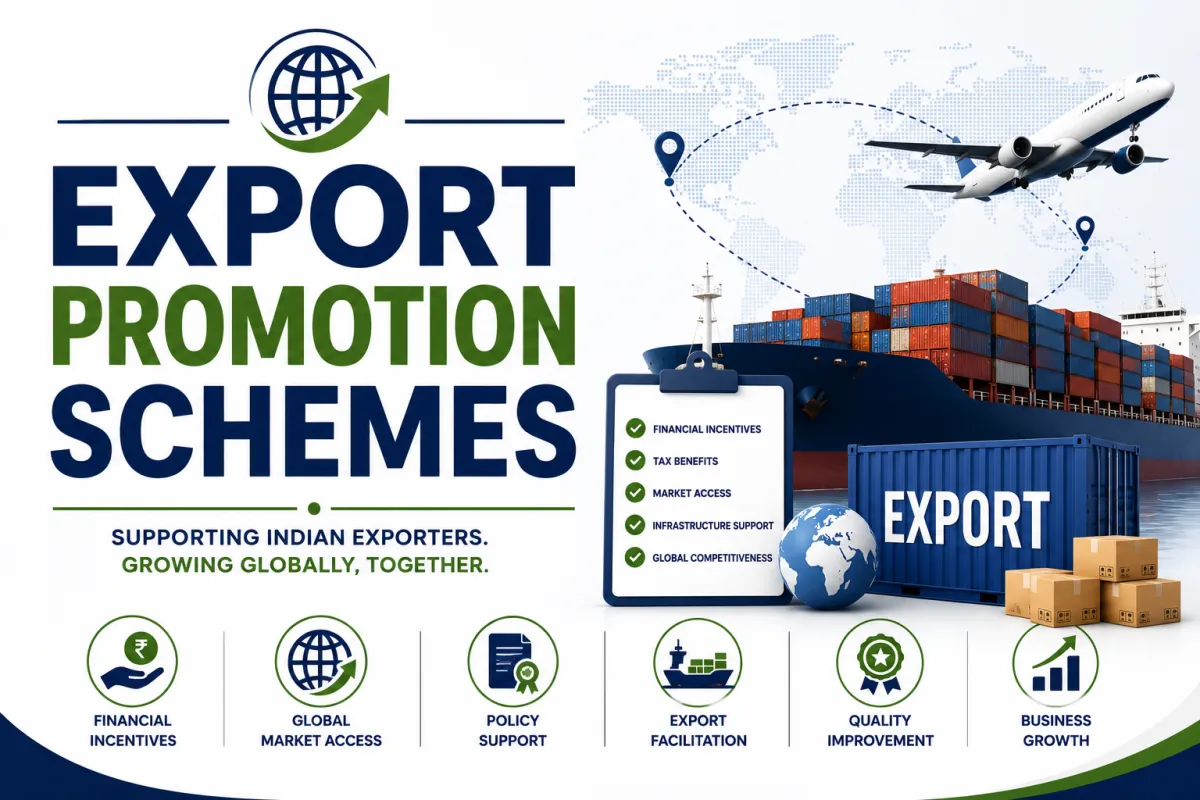
Export Promotion Schemes are government initiatives designed to encourage Indian businesses to expand into international markets. These schemes provide financial assistance, policy support, incentives, and infrastructure to help exporters improve global competitiveness and increase foreign trade.



Comments (0)
Please login to comment.