Audits are an essential part of effective business management, helping organizations maintain financial accuracy, improve operational efficiency, and comply with legal requirements. Among the various types of audits, internal audits and external audits are the most commonly conducted. Although both aim to enhance the reliability of financial information and strengthen organizational controls, they differ significantly in terms of purpose, scope, independence, reporting, and overall objectives. Understanding these differences enables business owners and management teams to use both audits effectively for long-term growth and regulatory compliance.
An internal audit is conducted by the organization’s internal audit team or by professionals appointed specifically to evaluate internal processes, financial controls, operational efficiency, risk management systems, and compliance procedures. The primary objective of an internal audit is to identify weaknesses, improve business operations, prevent fraud, strengthen internal controls, and support management in making informed business decisions. Internal audits are generally performed throughout the year based on the organization’s requirements and risk assessment.
An external audit, on the other hand, is performed by an independent Chartered Accountant or an audit firm that has no involvement in the company’s day-to-day operations. The main objective of an external audit is to provide an independent opinion on whether the company’s financial statements present a true and fair view in accordance with applicable accounting standards and legal requirements. External audits are often conducted annually and may be mandatory for certain entities under applicable laws.
The scope of an internal audit is much broader than simply reviewing financial statements. It includes evaluating internal controls, business processes, operational efficiency, inventory management, information systems, regulatory compliance, fraud prevention measures, and risk management practices. Internal auditors also recommend improvements that help management strengthen governance and achieve organizational objectives more effectively.
External audits primarily focus on examining financial statements, accounting records, supporting documents, statutory compliance, and financial reporting. Independent auditors verify whether financial information has been prepared accurately and whether material misstatements exist. Their findings are presented in an audit report that is shared with shareholders, regulatory authorities, financial institutions, investors, and other stakeholders wherever applicable.
Another important difference lies in reporting relationships. Internal auditors generally report their observations to senior management, the audit committee, or the board of directors to facilitate operational improvements. External auditors issue an independent audit report intended for shareholders and other external stakeholders who rely on the company’s financial statements for decision-making.
Both internal and external audits provide valuable benefits to businesses. Internal audits improve operational efficiency, strengthen internal controls, reduce business risks, detect potential fraud, and support better decision-making. External audits enhance financial credibility, improve investor confidence, facilitate access to business loans, strengthen corporate governance, and demonstrate compliance with statutory requirements. Together, they contribute to stronger financial discipline and greater organizational transparency.
Businesses can maximize the value of both audits by maintaining accurate accounting records, implementing effective internal controls, conducting regular reconciliations, preserving financial documentation, and ensuring timely statutory compliance. Using modern accounting software and seeking guidance from experienced Chartered Accountants further improves audit readiness and reduces compliance risks.
Understanding the differences between internal and external audits helps organizations appreciate the unique role each audit serves. While internal audits focus on continuous improvement and risk management within the organization, external audits provide independent assurance regarding the reliability of financial statements. Together, these audits strengthen financial reporting, improve governance, build stakeholder confidence, and support sustainable business growth.
Internal Audit vs External Audit: Understanding the Key Differences for Businesses

Akshii
@ Manaksh
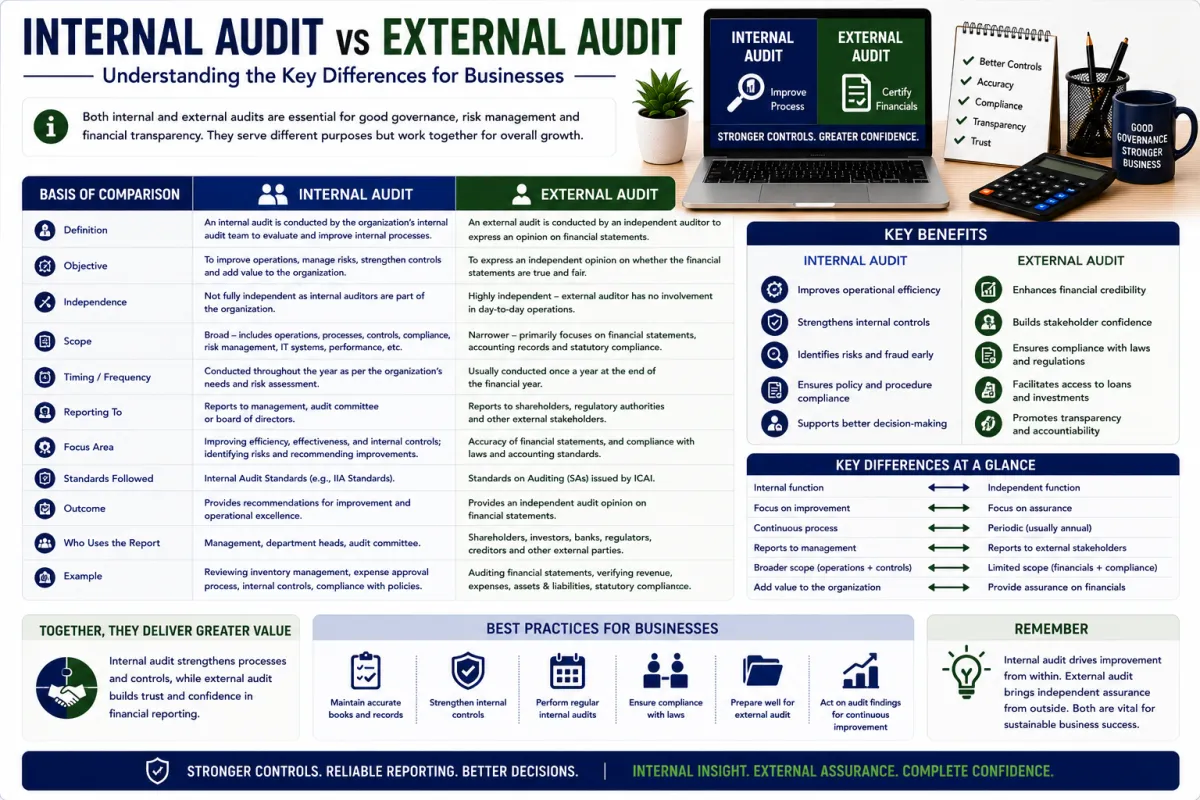
Internal and external audits both play important roles in strengthening a business’s financial management and governance. While an internal audit focuses on improving internal processes and risk management, an external audit independently verifies the accuracy of financial statements and compliance with applicable laws.



Comments (0)
Please login to comment.